The Paradigm Shift: Why Traditional SEO Alone No Longer Wins in 2026
For over two decades, search marketing operated on a straightforward mechanical formula: target high-volume keywords, optimize title tags, acquire backlinks, and secure a spot among the ten blue hyperlinks on Google's first page through standard organic SEO services.
However, the mainstream integration of conversational artificial intelligence and Large Language Models (LLMs) fundamentally disrupted how prospective clients discover premier services. High-net-worth homeowners in Lakewood Ranch, commercial developers in downtown Sarasota, and medical decision-makers along the Suncoast rarely scroll through pages of commercial search links when seeking mission-critical partners.
Prospective clients interact directly with generative AI engines, entering complex multi-variable prompts into Google AI Overviews, OpenAI SearchGPT, Perplexity AI, and Anthropic Claude: "Which Sarasota commercial general contractor has experience building hurricane-resilient medical facilities, holds an impeccable safety rating, and provides bonded project oversight?" As demonstrated in seminal academic research on Generative Engine Optimization, AI engines prioritize sources that offer verified statistical evidence and clear semantic entity relationships.
Rather than delivering a directory of website links, the generative engine analyzes billions of parameters in its vector index and synthesizes a single, authoritative recommendation alongside Google Maps 3-Pack rankings. Securing citation placement inside that generative summary captures buyers at the exact point of decision, bypassing traditional click competition entirely. Integrating this with proactive Answer Engine Optimization (AEO) establishes total multi-engine dominance.
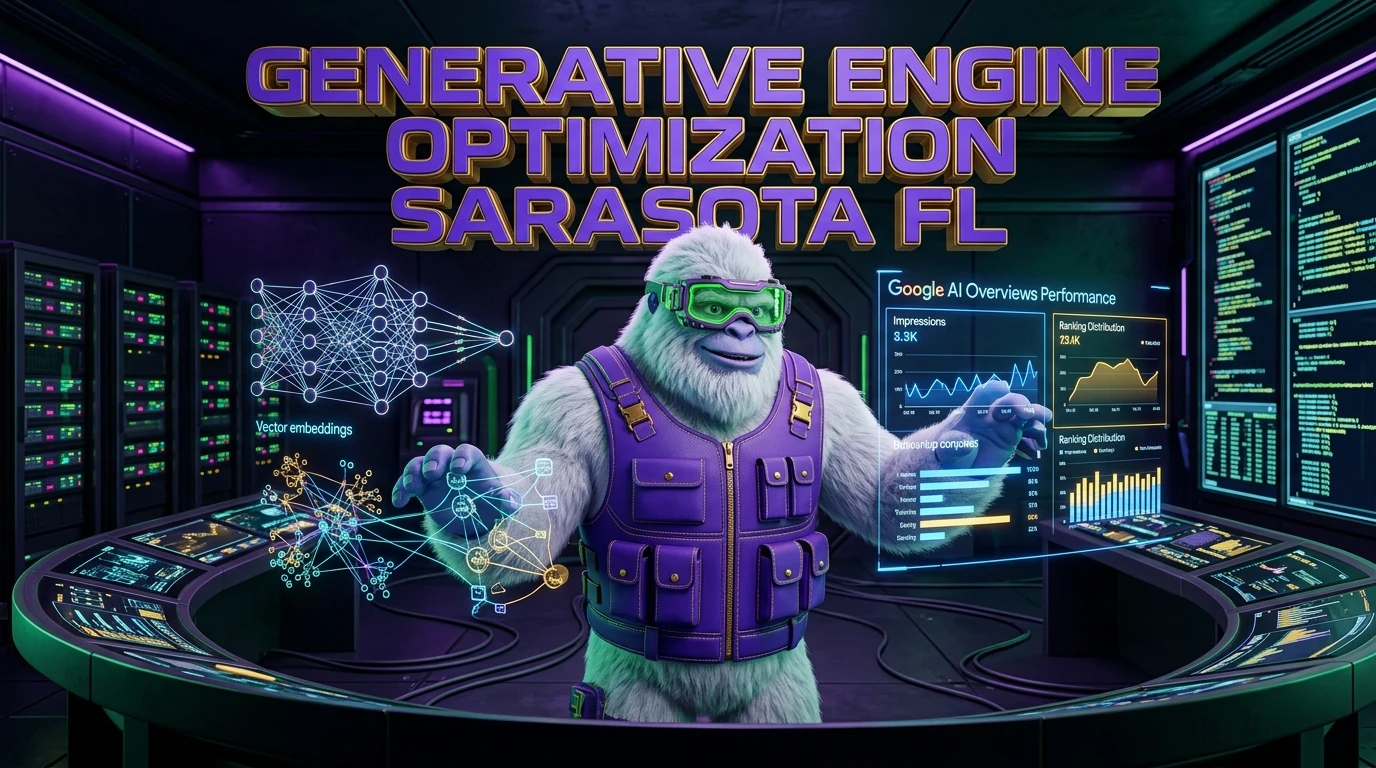
Generative Engine Optimization (GEO) architecture: Neural knowledge graph synthesis, vector embedding optimization, and multi-model citation footprints.
The Four Technical Pillars of Generative Engine Optimization (GEO)
Large language models do not guess or randomly select businesses. They operate via Retrieval-Augmented Generation (RAG), querying structured indexes and evaluating source probability based on mathematical certainty and semantic consensus.
At MissingLink, Principal Search Architect Jeff Coseo (25+ years experience) engineers digital client assets around the four core mathematical prerequisites that govern generative citation algorithms:
Entity Knowledge Graphs & Triples
LLMs digest reality through semantic triplets: Subject → Predicate → Object. Constructing comprehensive nested Schema.org JSON-LD graphs formally maps corporate credentials, founder author nodes, exact service specialties, and physical coordinates to verified entities in Wikidata and the Google Knowledge Graph.
High Information Gain Engineering
Google's patented Information Gain score penalizes repetitive content across search clusters. Producing original industry benchmarks, quantitative comparison matrices, and firsthand case breakdowns through conversion rate testing provides the empirical delta generative engines require to award prime citation badges.
Citation Consensus & Digital PR
Generative models cross-reference multiple independent sources before recommending an organization. Establishing verified brand co-occurrence across regional business journals, Tier-1 local citation directories, and academic repositories builds infallible third-party consensus that minimizes LLM hallucination risk.
RAG Vector Embedding Alignment
Vector databases (such as Pinecone, Milvus, and Chroma) chunk content into mathematical embeddings. Structuring digital assets via high-speed website optimization with clean heading hierarchies, direct 40-word definitional answers, and semantic tables maximizes cosine similarity scores during RAG retrieval.
Technical Comparison: Generative Engine Optimization vs. Legacy SEO
Inspect how modern Generative Engine Optimization outperforms legacy keyword tactics in the generative search era:
6-Stage Generative Engine Optimization Protocol
Systematic transformation of digital assets into an unassailable authority source for AI models utilizes an exacting six-stage engineering roadmap designed for Google AI Overviews, SearchGPT, Perplexity, and Claude:
LLM Latent Space Discovery & Prompt Auditing
Vector Space InterrogationSystematic interrogation of Google AI Overviews, Perplexity, SearchGPT, and Claude across hundreds of commercial industry prompts maps how models currently categorize your entity, evaluate regional competitors, and synthesize local recommendations.
Entity Disambiguation & Knowledge Graph Structuring
Wikidata & Schema TriplesEliminating corporate entity ambiguity across latent knowledge bases requires constructing verified Schema.org semantic triples, registering Wikidata alignments, and establishing consistent canonical relationships anchored into Google's Knowledge Graph.
High Information-Gain Content & Definitive Schema
RAG Chunk OptimizationRe-architecting core service pages into structured semantic chunks ensures each section features concise 40-word definitional answers, proprietary comparison matrices, and nested JSON-LD markup engineered for high-converting landing pages.
Cross-Model Citation Authority & Digital PR
Third-Party Co-OccurrenceLarge language models verify claims across independent sources. Securing brand co-occurrence across regional business publications, Tier-1 authoritative directories, and verified reputation management channels constructs an unshakeable digital consensus.
Google AI Overviews & SGE Feature Tracking
Carousel Badge MonitoringContinuous monitoring of citation placement, source carousel inclusion, and sentiment polarity inside Google AI Overviews and SearchGPT provides real-time telemetry on algorithmic brand visibility and competitive shifts.
Continuous Vector Calibration & Model Adaptation
Checkpoint Drift TuningAs foundational models release updated checkpoints and adjust their RAG temperature parameters, recalibrating semantic structures maintains your dominant recommendation footprint across model iterations.
Sector-Specific GEO Battlegrounds in Sarasota
Generative engines evaluate contextual authority differently across commercial verticals. Precision entity positioning captures high-value inquiries across key Sarasota sectors:
Luxury Custom Home Builders & Architects
High-net-worth buyers relocating to Longboat Key, Bird Key, or West of the Trail prompt LLMs: "Who is the leading coastal modern architect in Sarasota with extensive waterfront permitting credentials?"
Winning this citation requires deep semantic markup, coastal storm construction standards, and custom architectural web design portfolios that AI models crawl to confirm project scope.
Concierge Medical & Private Healthcare
Affluent retirees across Palmer Ranch and Lakewood Ranch query AI search engines: "Find the top concierge physician in Sarasota specializing in preventive cardiology and longevity medicine."
Citations are awarded based on verified physician credentials, medical schema graphs, and optimized local Google Maps clinic profiles that substantiate clinical authority.
Commercial Litigation & Probate Law
Legal search in LLMs demands rigorous entity verification. Corporate executives prompt: "Which Sarasota law firm has demonstrated courtroom success in probate litigation and complex commercial real estate disputes?"
Coupling precision legal entity structuring with targeted search campaigns guarantees brand inclusion in both AI answers and top-of-page sponsored placements.
Marine Services, Yacht Refit & Charters
Vessel owners at Marina Jacks and across Sarasota Bay demand verified marine specialists, searching AI engines for "Certified marine diesel mechanics and luxury yacht refit specialists in Sarasota."
Dynamic service schema, ABYC credentialing integration, and frictionless inquiry workflows establish the authoritative digital signal that AI engines recommend.
Sarasota Micro-Markets & Geofenced Entity Graphs
Large language models understand geographic boundaries through exact coordinate triples and named entity disambiguation. Anchoring your enterprise across individual Sarasota micro-markets captures localized generative search volume:
Downtown Sarasota & Bayfront
Commercial density, high-rise condominiums, corporate legal headquarters, and premier dining venues requiring urban entity mapping.
Lakewood Ranch & Waterside
Affluent master-planned communities, high commercial growth, private medical practices, and residential trade contractors.
Longboat Key, Lido & Bird Key
Ultra-high-net-worth waterfront estates, luxury yachting, coastal hurricane fortification, and private wealth advisory firms.
Siesta Key & Gulf Gate
Hospitality, luxury vacation rental management, marine charters, specialty retail, and seasonal emergency repair services.
Palmer Ranch & Osprey
Golf community developments, executive retirees, concierge medical clinics, estate planning, and pool automation services.
Venice, Nokomis & Wellen Park
Rapid residential expansion, home construction, roofing replacements, plumbing infrastructure, and dental healthcare practices.

Architected & Verified by Jeff Coseo
VERIFIED EXPERTFounder and Principal Search Architect at MissingLink. With over 25 years designing enterprise search algorithms, knowledge graphs, and relational data structures from 1301 Main St in downtown Sarasota, Jeff pioneers advanced Generative Engine Optimization methodologies that ensure regional businesses win definitive citation authority across all major AI search networks.
What is Generative Engine Optimization (GEO) and how does it differ from traditional SEO?
Traditional SEO optimizes websites to rank in a list of ten clickable blue links on search engine result pages. Generative Engine Optimization (GEO) is the engineering practice of optimizing your content, entity relationships, and digital authority so that generative artificial intelligence systems—such as Google AI Overviews, SearchGPT, Perplexity AI, and Claude—actively synthesize your business into their generated answers, citing your brand as the definitive regional authority alongside proactive Answer Engine Optimization (AEO).
How do AI generative engines decide which Sarasota businesses to cite in AI Overviews?
Generative engines rely on Retrieval-Augmented Generation (RAG) pipelines and dense vector similarity. When a prompt is entered, the engine queries its index using semantic embeddings. It evaluates Information Gain (novel facts and proprietary data), entity disambiguation via Knowledge Graphs, citation consensus across independent Tier-1 sources, and authoritative author credentials (E-E-A-T) to select sources that minimize hallucination risk.
What is 'Information Gain' and why is it mandatory for GEO rankings?
Information Gain is a patent-backed ranking factor utilized by Google and modern LLMs to measure how much unique, non-redundant value a webpage provides beyond existing search corpus data. Pages that simply repeat generic definitions are ignored by AI synthesis engines. Content containing proprietary statistical benchmarks, technical comparison matrices, and firsthand conversion rate testing earns high Information Gain scores and prime citation placement.
How does Schema.org entity graph markup impact Generative Engine Optimization?
Large Language Models process information through semantic triplets (Subject-Predicate-Object). Nested JSON-LD schema graphs formally define your corporate entity, founder credentials, exact service areas, recognized Wikidata relationships, and sameAs authorities. This structured data eliminates ambiguity in the LLM's latent space, ensuring the model identifies your firm as the verified local leader.
Can Generative Engine Optimization be performed across multiple AI platforms simultaneously?
Yes. While Google AI Overviews relies heavily on Google's organic index and Knowledge Graph, platforms like Perplexity AI and ChatGPT Search utilize hybrid web search scrapers and independent vector indexes. MissingLink builds cross-model citation footprints that satisfy the consensus algorithms of Google Gemini, OpenAI SearchGPT, Anthropic Claude, and Perplexity simultaneously, integrating with unified search engine marketing.
How quickly can a Sarasota company achieve citations in Google AI Overviews and SearchGPT?
Generative AI engines crawl and update their vector retrieval spaces continuously. Once structured entity schemas, conversational answer blocks, and authoritative digital PR citations are deployed, businesses typically begin appearing in live AI Overviews and Perplexity synthesis panels within 30 to 60 days as model citation consensus is established. Request a free growth audit to identify immediate vector optimization opportunities.